



AMD’s Threadripper Pro 9000 “Leaves Intel in the Dust” as Content Creators Rejoice Over Intel’s Struggling Performance
 By
Naomi Adeyemi
By
Naomi Adeyemi
| IN A NUTSHELL |
|
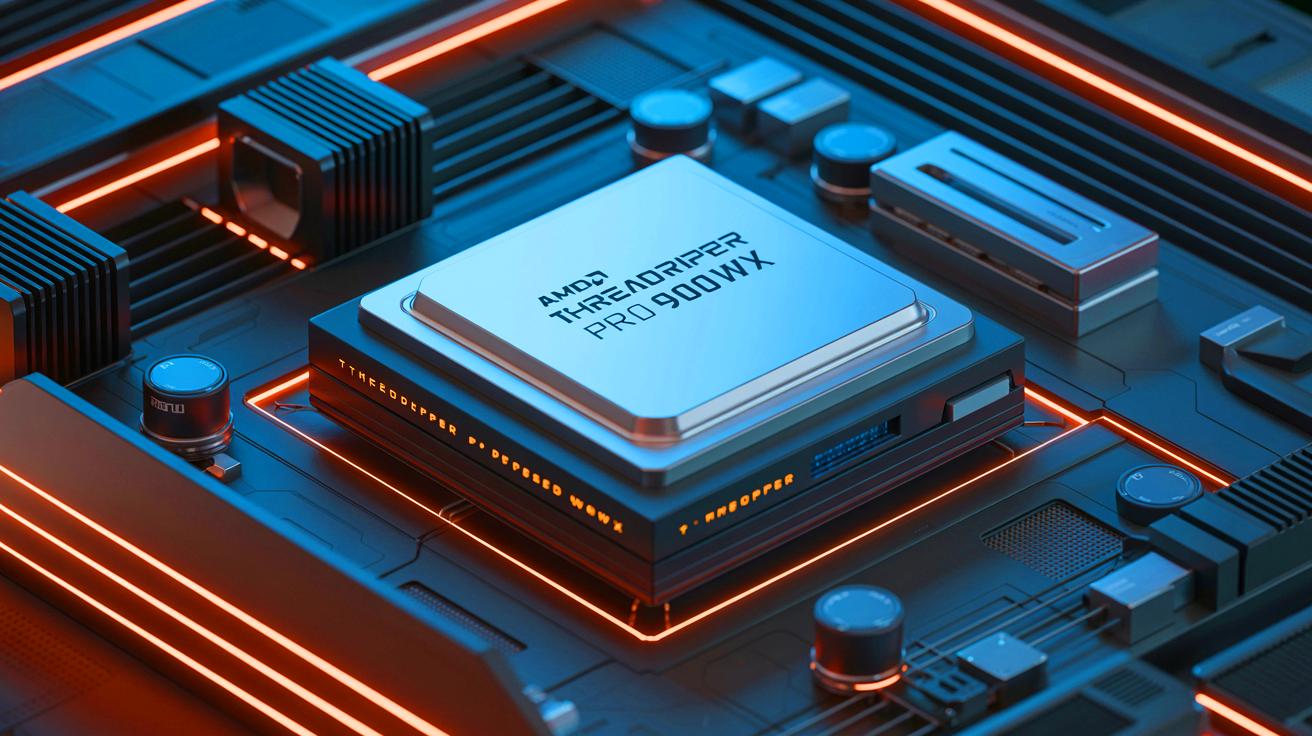
In the ever-evolving landscape of computer processors, AMD has once again made headlines with its latest Threadripper PRO 9000WX series. The newest entries in AMD’s lineup have not only outperformed Intel’s Xeon processors but have also set new benchmarks for content creation and professional workstation applications. This development signifies a pivotal moment in the ongoing rivalry between AMD and Intel, as technological advancements push the boundaries of performance in creative and professional computing environments.
AMD’s Threadripper Dominance in Content Creation
The release of AMD’s Threadripper PRO 9000WX series has marked a significant shift in the balance of power in the processor market. Benchmarks from Puget Systems reveal that AMD’s new processors outperform Intel’s Xeon CPUs in a variety of real-world applications. These include video editing and rendering tasks in Premiere Pro, DaVinci Resolve, and After Effects. The results are clear: AMD’s higher core density and sustained throughput offer significant advantages in content creation workflows.
One of the standout performers in AMD’s lineup is the 96-core 9995WX, priced at $11,700. This processor has achieved a Cinebench 2024 multi-core score of 7,508, which is 27% ahead of AMD’s previous generation and a staggering 125% faster than Intel’s most powerful Xeon. These figures highlight AMD’s commitment to pushing the envelope in terms of both performance and efficiency.
Even AMD’s mid-range offerings, like the 32-core 9975WX, have outperformed Intel’s 60-core Xeon processors in tasks such as Blender and Unreal Engine compiling. This consistent outperformance underscores a clear trend: AMD is setting the pace in the realm of content creation.
Intel’s Struggles to Compete
As AMD continues to push the boundaries with its Threadripper series, Intel finds itself in a challenging position. The Xeon series, once considered the standard for professional workstations, is now struggling to keep up with AMD’s rapid advancements. In Photoshop, a program where high single-core speed is crucial, AMD’s 16-core 9955WX outperformed Intel’s Xeon w5-3535X with an overall score of 11,384 compared to 6,801. This result not only highlights AMD’s superior single-core performance but also raises questions about the efficiency of Intel’s current offerings.
The disparity is further highlighted in Adobe’s suite of creative tools, where even the weakest Threadripper 9000 chip outperformed every Intel CPU tested. These results are a testament to AMD’s strategic focus on optimizing processor performance for creative and professional applications. The implications for Intel are significant, as they must now innovate to regain their competitive edge.
The Technical Edge of AMD’s Processors
AMD’s success with the Threadripper PRO 9000WX series can be attributed to several technical innovations. The incorporation of high core density within the processors allows for better multitasking capabilities, which is essential for content creators who often run multiple applications simultaneously. Additionally, the sustained throughput offered by these processors ensures that they can handle intensive tasks without performance degradation.
In After Effects 3D workloads, AMD’s 9955WX processor demonstrated a 9% lead over its own 9995WX and a 40% advantage over Intel’s top performer. This demonstrates not only AMD’s dominance in multi-core performance but also its efficiency in handling complex tasks. Furthermore, in AI-related benchmarks, AMD’s processors showed consistent scaling, processing 16% more tokens per second than their predecessors.
The support for DDR5-6400 memory in AMD’s new processors provides additional performance benefits, making them an attractive option for professionals seeking the latest technology to enhance their workflows.
The Future of Workstation Processors
AMD’s recent advancements with the Threadripper PRO 9000WX series highlight the dynamic nature of the processor industry. The company’s ability to consistently outperform Intel in key performance metrics suggests a promising future for AMD in the professional workstation market. However, Intel’s recent struggles may prompt a strategic reevaluation as they attempt to regain their footing.
The price increase of AMD’s new processors, ranging from 10% to 20% over the previous generation, reflects the added value these advancements bring. While this may raise the cost for consumers, the performance gains justify the investment for many professionals. The question remains whether Intel can respond with innovations that will once again level the playing field.
As AMD continues to lead the charge in processor innovation, the industry watches closely to see how Intel will respond. Will Intel rise to the challenge and reclaim its position as a leader in the workstation market, or will AMD’s momentum pave the way for a new era of computing dominance?