

Google Genie 3: “This Changes Everything!” Experts Shocked by Real-Time 3D World Creation and Exploration
 By
Naomi Adeyemi
By
Naomi Adeyemi
| IN A NUTSHELL |
|
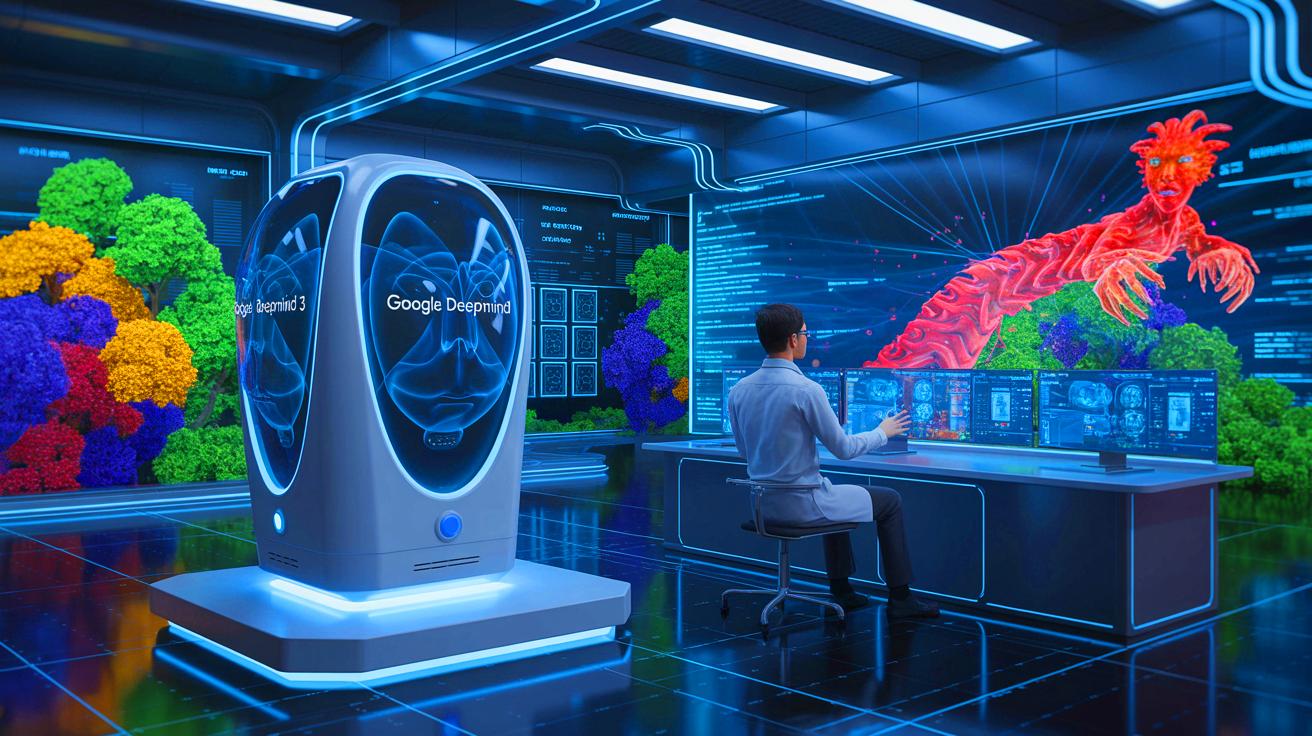
As technology continues to evolve, Google DeepMind has made significant strides with the unveiling of Genie 3, a state-of-the-art AI world model. This model allows users to generate, explore, and interact with a 3D environment in real-time. Unlike its predecessor, Genie 2, the new model offers enhanced interaction capabilities and delivers impressive 720p quality. While the technology is still in its testing phase, its potential applications are vast, ranging from gaming to AI research. In this article, we delve into the features, improvements, and future prospects of Google DeepMind’s latest innovation.
The Evolution of AI World Models
Google DeepMind’s Genie 3 represents a significant leap forward in the development of AI world models. The journey began with GameNGen, which laid the foundation for subsequent advancements. Genie 2 marked an important milestone by introducing more sophisticated interaction features. Now, with Genie 3, users can experience real-time interaction with 3D environments, a feature that was previously unattainable.
This latest iteration allows users to immerse themselves in a world where they can generate and modify environments on the fly. The technology’s ability to maintain consistency and realism is a testament to Google’s commitment to pushing the boundaries of AI capabilities. The introduction of the ‘interaction horizon’ further enhances the experience, enabling users to interact with the environment over several minutes rather than being confined to brief interactions.
Beyond its technical prowess, Genie 3’s release signals a shift towards more dynamic and immersive AI models, setting the stage for future developments in artificial intelligence.
Real-Time Interaction and Immersion
One of the standout features of Genie 3 is its capacity for real-time interaction. Users can create a 3D world, explore it, and interact with various elements seamlessly. This capability is akin to merging AI and VR technologies, allowing for a level of immersion that was previously limited to high-end virtual reality systems.
Genie 3’s ability to persist objects within the created environments adds to the realism. For example, users can paint a wall in the virtual space, walk away, and return to see their changes intact. This feature not only enhances the user experience but also offers practical applications for developers and researchers.
Despite its limitations, such as the inability to simulate real-world locations with perfect geographic accuracy, Genie 3 is a remarkable achievement in AI technology. As Google continues to refine this model, we can anticipate even more sophisticated features in future iterations.
Potential Applications and Limitations
The applications of Genie 3 are extensive, with potential uses in fields ranging from gaming to AI research. Game developers can utilize the model to create and test new environments and characters, while researchers can explore the possibilities of training AI agents in immersive settings. Google’s vision for Genie 3 extends beyond entertainment, positioning it as a step towards achieving Artificial General Intelligence (AGI).
However, the current version of Genie 3 is not without its constraints. The world model supports only a few minutes of interaction, limiting its use for extended sessions. Additionally, its availability is restricted to a select group of testers, with Google exploring ways to expand access in the future. Despite these limitations, the technology’s potential is undeniable, and its development is a promising sign for the future of AI.
As Genie 3 continues to evolve, it will be fascinating to see how its capabilities expand and how it influences various industries.
The Future of AI World Models
Looking ahead, the future of AI world models like Genie 3 appears bright. Google’s commitment to innovation and improvement suggests that we can expect even more advanced iterations in the coming years. Whether through an expansion of Genie 3 or the eventual release of Genie 4, the potential for AI models to transform industries is immense.
While the current focus is on enhancing real-time interaction and environmental consistency, future developments may include extended interaction periods and more accurate geographic simulations. As AI models become more sophisticated, their applications will likely broaden, impacting sectors ranging from education to healthcare.
As we continue to explore the possibilities of AI technology, one question remains: How will these advancements shape our future interactions with digital environments and the world at large?